
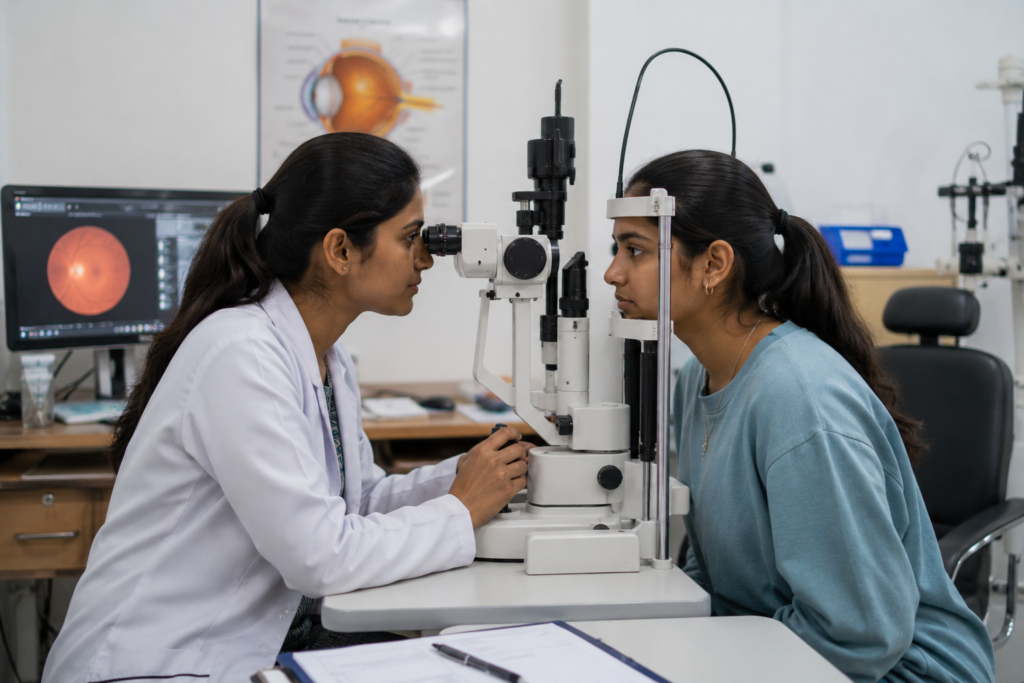
Choosing the right healthcare program after Class 12 is an important decision, especially if you want a career that combines patient care with advanced medical technology. If you are planning to pursue a BSc Optometry Course in India, understanding the admission process beforehand can help you avoid common mistakes and improve your chances of securing a seat at a reputed institution.
The admission process differs across universities, yet most colleges follow similar eligibility criteria, document verification, and selection procedures. Therefore, preparing early allows you to complete every step confidently and on time.
Students often search for reliable BSC Optometry admission guidance because admission requirements vary between states and universities. This guide explains the complete process, eligibility requirements, required documents, selection methods, and important factors to consider before choosing a college.
According to the Ministry of Health and Family Welfare, India continues to strengthen its healthcare workforce to meet the growing demand for quality eye care services. Moreover, increasing awareness about vision health, digital eye strain, and preventive eye examinations has created greater demand for qualified optometry professionals. As a result, selecting the right institution has become more important than ever.
Why Should You Choose a BSc Optometry Course in India?
A BSc Optometry Course in India prepares students to become primary eye care professionals who assist in vision assessment, eye disease detection, contact lens practice, and rehabilitation services. Unlike many healthcare programs, optometry combines clinical knowledge with modern diagnostic technology.
Furthermore, students receive practical exposure through hospital training, vision screening camps, and clinical internships, making them industry-ready before graduation.
Some major advantages include:
- Strong demand in hospitals and eye care centers
- Extensive clinical learning opportunities
- Growing healthcare sector in India
- Opportunities for higher education and specialization
- Exposure to advanced ophthalmic diagnostic equipment
According to the National Programme for Control of Blindness and Visual Impairment (NPCBVI), regular vision screening and early diagnosis remain national healthcare priorities, increasing the importance of trained optometrists across urban and rural India.
Who Is Eligible for a BSc Optometry Course in India?
Before applying, ensure you meet the eligibility requirements of your preferred institution. Understanding these requirements early can help you prepare the necessary documents and avoid delays during the admission process. Seeking reliable BSC Optometry admission guidance can also help you stay updated on university-specific eligibility criteria and admission requirements.
Basic Eligibility Criteria
Most universities require candidates to have:
| Eligibility Requirement | Details |
|---|---|
| Educational Qualification | 10+2 or equivalent |
| Stream | Science |
| Mandatory Subjects | Physics, Chemistry, Biology and/or Mathematics (varies by university) |
| Minimum Academic Performance | As prescribed by the respective institution |
| Medical Fitness | Required by some colleges |
Although eligibility criteria remain similar nationwide, universities may introduce additional selection requirements. Therefore, always verify the latest admission notification before applying.
How Can You Get Admission to a BSc Optometry Course in India?
The admission process generally follows a structured sequence. Completing each stage carefully improves your chances of admission.
Step 1: Shortlist Recognized Colleges
Begin by identifying universities and institutions recognized by relevant educational authorities. Accreditation, hospital partnerships, experienced faculty, and internship opportunities should influence your decision.
Additionally, compare placement support, laboratory facilities, and curriculum before making your final choice.
Step 2: Check Admission Notifications
Most colleges release admission notifications several months before the academic session begins.
Admission announcements usually include:
- Eligibility criteria
- Application timeline
- Selection process
- Required documents
- Counselling schedule
Applying early helps avoid last-minute issues during document verification.
Step 3: Submit the Application Form
Most institutions now provide online application facilities.
Before submitting your application:
- Verify all personal details.
- Upload clear documents.
- Double-check academic information.
- Review the application before final submission.
Simple errors often delay verification. Therefore, accuracy matters throughout the application process.
Step 4: Participate in the Selection Process
Different universities follow different admission methods.
Some institutions offer admission based on:
- Class 12 academic performance
- University-level entrance examination
- Personal interview
- Merit-based counselling
- Combined evaluation process
Therefore, review the admission criteria of each college individually instead of assuming every institution follows the same process.
Step 5: Complete Document Verification
Once shortlisted, candidates must attend document verification.
Generally, colleges verify:
- Academic certificates
- Identity proof
- Recent photographs
- Category certificates (if applicable)
- Transfer and migration certificates
- Character certificate
Incomplete documentation may delay admission. Consequently, keep both original and photocopies ready before verification.
Which Documents Are Required During Admission?
Preparing documents in advance makes the admission process significantly smoother.
Essential Documents Checklist
| Document | Purpose |
| Class 10 Mark Sheet | Date of birth verification |
| Class 12 Mark Sheet | Academic eligibility |
| Transfer Certificate | Institutional transfer |
| Migration Certificate | Applicable for certain boards |
| Government Identity Proof | Identity verification |
| Passport-size Photographs | Admission records |
| Category Certificate | Reservation benefits (if applicable) |
| Medical Fitness Certificate | Required by selected institutions |
Keeping scanned copies organized also simplifies the online application process.
Is Merit-Based Admission or Entrance-Based Admission Better?
The answer depends on the university you choose.
Some reputed institutions admit students solely through academic merit. Others conduct entrance examinations to evaluate scientific aptitude and analytical skills.
Therefore, students should prepare for both possibilities instead of relying on only one admission route.
Moreover, institutions that conduct entrance examinations often assess:
- Biology fundamentals
- Physics concepts
- Chemistry basics
- Logical reasoning
- General aptitude
Preparing these subjects in advance increases admission opportunities across multiple colleges.
Also Read : BSc Optometry Entrance Exams 2026: Important Dates, Eligibility & Preparation Tips
How Should You Choose the Right BSc Optometry College?
Selecting the right institution is as important as securing admission. A well-established college offers quality education, practical exposure, experienced faculty, and strong industry connections. Therefore, instead of choosing a college based only on popularity, evaluate multiple academic and clinical factors.
What Should You Check Before Finalizing a College?
Use the following checklist while comparing institutions.
| Selection Factor | Why It Matters |
|---|---|
| University Recognition | Ensures the degree is widely accepted. |
| Hospital Tie-ups | Provides clinical exposure and internships. |
| Modern Laboratories | Helps students learn advanced diagnostic techniques. |
| Experienced Faculty | Improves practical and theoretical understanding. |
| Internship Opportunities | Builds real-world clinical skills. |
| Placement Assistance | Supports career readiness after graduation. |
| Research Activities | Encourages innovation and evidence-based learning. |
| Student Support Services | Improves the overall academic experience. |
Moreover, visit the campus whenever possible. Speaking with current students and faculty can provide valuable insights into the learning environment.
Before selecting a BSc Optometry Course in India, compare accreditation, clinical training, and internship opportunities.
Why Is Clinical Training Important in a BSc Optometry Course in India?
Clinical exposure bridges the gap between classroom learning and professional practice. While theoretical knowledge forms the foundation, practical experience develops confidence and patient-handling skills.
During training, students typically learn to:
- Conduct comprehensive eye examinations
- Perform vision assessments
- Fit and evaluate contact lenses
- Use ophthalmic diagnostic instruments
- Detect common vision disorders
- Assist ophthalmologists during patient care
According to the National Programme for Control of Blindness and Visual Impairment, early diagnosis remains one of the most effective strategies for reducing preventable vision loss in India. Consequently, practical training has become an essential component of optometry education.
What Skills Will You Develop During the Course?
A successful optometrist requires more than academic excellence. The profession demands technical expertise, communication skills, and ethical patient care.
Students gradually develop:
- Clinical observation skills
- Critical thinking
- Problem-solving ability
- Communication with patients
- Diagnostic decision-making
- Time management
- Professional ethics
- Teamwork in healthcare settings
Furthermore, regular clinical practice improves confidence while working with patients from different age groups.
What Are the Career Opportunities After Completing the Course?
A BSc Optometry Course in India opens doors to diverse healthcare settings. As eye care awareness continues to grow, qualified professionals are needed across hospitals, clinics, research centers, and optical industries.
Graduates may explore opportunities in:
- Multi-specialty hospitals
- Eye care hospitals
- Vision care clinics
- Optical retail chains
- Community healthcare programs
- Diagnostic centers
- Corporate vision screening initiatives
- Academic institutions
- Clinical research organizations
According to the World Health Organization (WHO), more than 2.2 billion people worldwide experience vision impairment or blindness. Nearly half of these cases are preventable or remain untreated. This growing global need highlights the increasing importance of trained eye care professionals.
Graduates of a BSc Optometry Course in India are increasingly preferred by hospitals and vision care centers.
Can You Pursue Higher Studies After Graduation?
Yes. Many graduates continue their education to enhance clinical expertise and expand career opportunities.
Popular options include:
- Master of Optometry (M.Optom)
- MSc in Optometry
- Fellowship Programs
- Clinical Vision Science
- Pediatric Optometry
- Contact Lens Practice
- Low Vision Rehabilitation
- Public Health Research
Higher education also supports careers in teaching, research, and specialized clinical practice.
Common Mistakes Students Should Avoid During Admission
Even academically strong students sometimes make avoidable admission mistakes. Fortunately, careful planning helps prevent unnecessary delays.
Avoid these common errors:
- Applying without checking eligibility requirements.
- Ignoring university recognition.
- Missing application deadlines.
- Uploading incorrect documents.
- Choosing a college without evaluating clinical exposure.
- Overlooking internship opportunities.
- Failing to verify admission notifications.
- Not seeking reliable BSC Optometry admission guidance before applying.
Planning ahead not only reduces stress but also increases the likelihood of securing admission to a reputed institution.
Important Admission Timeline Checklist
Although admission schedules differ among universities, most institutions follow a similar sequence.
| Admission Stage | Student Action |
| Admission Notification | Review eligibility and important dates. |
| Online Registration | Complete the application accurately. |
| Document Upload | Submit clear and valid documents. |
| Merit List or Entrance Test | Monitor official announcements. |
| Counselling Process | Attend as scheduled. |
| Document Verification | Carry original documents. |
| Admission Confirmation | Complete institutional formalities. |
Keeping track of official notifications helps students avoid missing important deadlines.
Where Can Students Find Authentic Admission Information?
Students should always rely on official sources instead of social media rumors or unofficial portals.
Useful resources include:
- Official university admission portals
- Government education websites
- Recognized healthcare institutions
- Admission notification brochures
- The National Education Policy (NEP 2020) framework available on the official Government of India website.
Additionally, understanding the field of Optometry through the Wikipedia article on the subject can help students gain foundational knowledge before applying.
Using authentic sources ensures accurate and up-to-date admission information.
How Can Educareer360 Help You Get Admission to a BSc Optometry Course?
Navigating the admission process can be challenging, especially when different universities follow different eligibility criteria, selection methods, and documentation requirements. This is where Educareer360 can simplify your admission journey. With years of experience in admission counselling, Educareer360 helps students make informed decisions by providing personalized guidance based on their academic profile and career goals. The consultancy supports students throughout the admission process, from shortlisting suitable colleges and understanding eligibility requirements to completing applications and document verification. Educareer360 also assists students in staying updated with the latest admission notifications and counselling schedules, ensuring they never miss an important opportunity. Its expert counselling team has guided thousands of students toward admissions in reputed healthcare, engineering, and management institutions across India.
Educareer360 helps students secure admission to the right BSc Optometry Course in India based on their academic profile and career aspirations.
If you would like to explore available admission options and learn more about the guidance process, visit our Home Page. For personalized counselling or one-to-one admission support, feel free to reach out through our Contact Us page, and our admission experts will be happy to assist you.
Conclusion
Getting admission to a BSc Optometry Course in India becomes much easier when you understand the eligibility requirements, application process, document verification, and college selection criteria in advance. Instead of applying randomly, focus on choosing a recognized institution that offers strong clinical training, experienced faculty, and excellent internship opportunities.
Moreover, staying updated with official admission notifications and preparing your documents early can save valuable time during the admission cycle. As India’s healthcare sector continues to expand, qualified optometry professionals will play an increasingly important role in preventive eye care, vision rehabilitation, and advanced diagnostic services.
Choosing the right BSc Optometry Course in India is the first step toward a successful healthcare career.
If you are serious about building a rewarding career in eye care, begin your admission planning early and seek reliable BSC Optometry admission guidance whenever needed. With the right preparation and informed decisions, you can confidently secure admission to a reputed institution and take the first step toward a successful healthcare career.
Frequently Asked Questions (FAQs)
1. How can I get admission to a BSc Optometry Course in India?
Admission is generally based on Class 12 merit, university-level entrance exams, or a combination of both, depending on the institution. Candidates must meet the eligibility criteria, submit the required documents, and complete the counselling or selection process as prescribed by the college.
2. What subjects are required after Class 12 for BSc Optometry?
Most colleges require students to complete Class 12 with Physics, Chemistry, and Biology. Some universities also accept Mathematics as an eligible subject combination. However, eligibility requirements may vary between institutions.
3. Is NEET compulsory for admission to BSc Optometry?
No. NEET is not mandatory for admission to most BSc Optometry programs in India. Many universities offer admission based on Class 12 marks or conduct their own entrance examinations. Students should always verify the admission criteria on the official website of their chosen institution.
4. What documents are commonly required during the admission process?
Students typically need their Class 10 and 12 mark sheets, transfer certificate, migration certificate (if applicable), government-issued identity proof, passport-size photographs, and category certificate (where applicable). Some colleges may also request a medical fitness certificate.
5. How do I choose the best BSc Optometry college?
Look for factors such as university recognition, hospital affiliations, internship opportunities, experienced faculty, modern laboratories, research facilities, placement support, and student reviews. Comparing these aspects helps you select an institution that aligns with your academic and career goals.
